
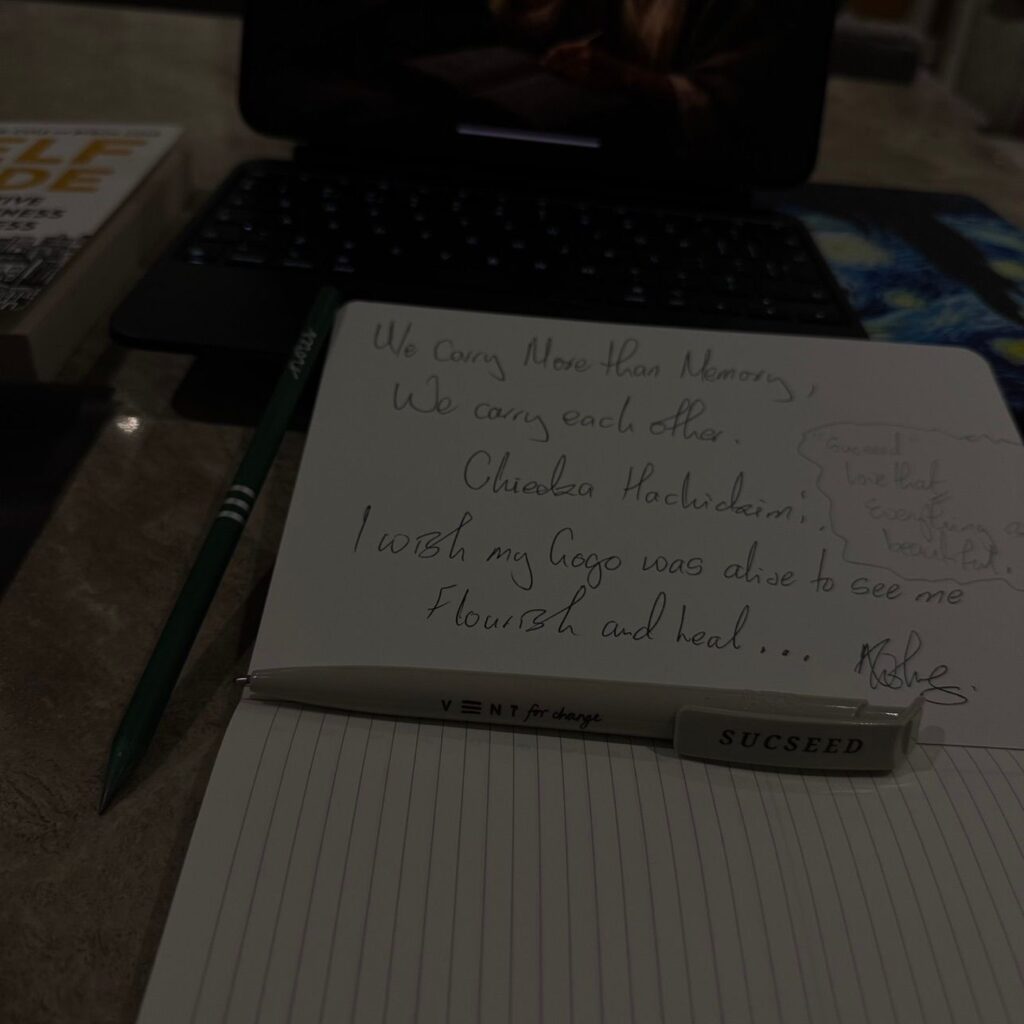
For those of us navigating the Zimbabwean-British experience, identity is rarely a straight line. It is a series of intersections, a constant negotiation between the red dust of a remembered home and the grey dampness of the soil we currently tread. We are the architects of a bridge that spans oceans, and often, we find ourselves standing in the middle, buffeted by winds from both directions.
Finding one's way back to the self is not a journey of distance, but of excavation. It requires us to peel back the layers of societal expectation and colonial residue to find the "Ancestral Anchor": that deep, unshakeable part of our spirit that remains connected to the source. A self discovery journal becomes more than a book; it is a map of the internal landscape, a record of the rebellion inherent in simply choosing to be whole.

Who chose your name, and what were they hoping for when they spoke it into existence? In many cultures, a name is a prophecy. For the Zimbabwean woman in London, a name can be a shield or a point of friction. Write to the person you were named after, or the ancestor who first carried your lineage’s title. Ask them what it felt like to be the first to carry that sound. Tell them how the world says your name now, and how you say it when you are alone.
Every family has a blueprint of silence. Perhaps it is the silence of the liberation struggle, the silence of the migration journey, or the silence of things deemed "un-African" to discuss. In your journaling prompts for healing, identify one pattern of silence you have inherited. Does it manifest as a tightness in your chest or a habit of retreating when things get difficult? Describe what it would look like to breathe into that space.

We often focus on the trauma of those who came before us, forgetting that they also laughed, danced, and loved under impossible circumstances. Think of a specific strength you see in your mother, your Gogo, or an aunt. Is it the way she commands a room without speaking? Is it her ability to find beauty in a sparse garden? This trait lives in your marrow. Write about how you can honor this inherited joy today without feeling the need to "earn" it through suffering.
Describe a place tied to your heritage using all five senses. Perhaps it is the smell of rain on hot Zimbabwean earth or the sound of the wind through the high rises of a British city. How do these two environments conflict within you? When you close your eyes and seek "home," which version of the earth do you feel beneath your feet? Grounding yourself requires acknowledging that you are native to the transition itself.
Ritual is the thread that keeps us from unraveling. Whether it is the specific way tea is served or the communal effort of preparing sadza, these acts are ancestral anchors. Record a ritual that makes you feel connected to your people. If you feel disconnected, what is a small, quiet practice you can begin today to reclaim that thread? Use your journal to reinvent a tradition that fits the life you are living now.

Recall a moment where you felt "carried" through a hardship. In the quiet moments of your healing journey, who do you imagine was standing behind you? If you were to imagine an ancestor acting as a guardian, who would it be? Write down the words you believe they were whispering to you when you thought you couldn't go on.
There are parts of our history we will never know: records lost, stories taken to the grave, or the intentional fog of the diaspora. These gaps can feel like wounds, but they can also be treated as sacred spaces. What questions have you always wanted to ask your elders but never could? Instead of mourning the missing answers, use your self discovery journal to imagine the most beautiful, empowering possibility for those "unseen" parts of your story.
Look at the patterns of the masculine and feminine in your lineage. Perhaps the women were the pillars of strength while the men were the keepers of the stories, or vice versa. How do these roles live in your body? In our companion books, we often explore how societal expectations of "strength" can become a prison. Write about the balance you are seeking: the permission to be both soft and unyielding.

If you were to choose one object to represent your journey back to yourself, what would it be? It could be a piece of jewelry, a photograph, or even a specific stone. Describe this object in vivid detail. Why does it feel like a doorway? Placing value on the physical symbols of our heritage is a way of anchoring the spirit in a world that often tries to make us invisible.
One day, a hundred years from now, someone will look at your life to find their own way home. What patterns are you healing now so that they don't have to? What light are you carrying forward? Your Rising After the Storm is not just for you; it is a blueprint for those who will follow. Write a message to your future descendants about what it means to be grounded, rooted, and unapologetically yourself.

Journaling is not merely a hobby; it is a radical act of reclamation. When we use journaling prompts for healing, we are refusing to let our stories be written by anyone else. We are choosing to be the masters of our own narratives, the keepers of our own light.
At Chiedza Innovations, we believe that every woman carries a universe within her. Our guided journals are designed to be the vessel for that exploration. Whether you are navigating the weight of the diaspora or the quiet storm of a personal transition, remember that you are anchored by a history that is as deep as it is resilient.
Take your time with these prompts. Let them sit with you. The journey back to yourself is not a race; it is a homecoming. And you are already on your way.