
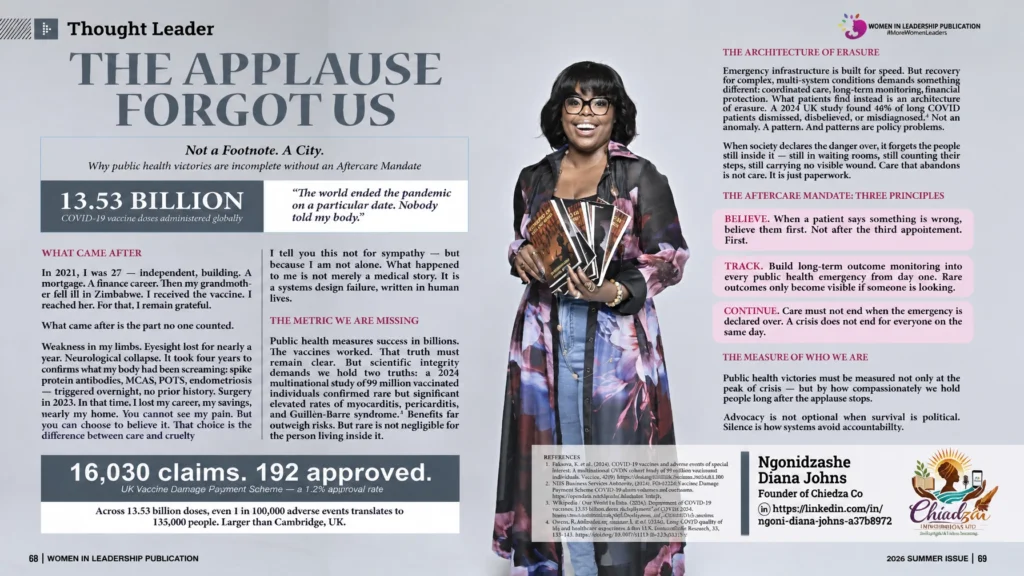
When the invitation from Women in Leadership magazine landed in my inbox, my first instinct wasn’t to celebrate. It was to look at my reflection in the mirror: a reflection currently framed by the metal bars of my wheelchair: and wonder if they’d sent the email to the wrong person.
I’m Ngoni Diana Johns. I am a Zimbabwean-British woman. I am a writer, a publisher, and a woman living with the daily, grinding reality of chronic illness. Usually, when people think of "Leadership," they think of power suits and glass ceilings. They don’t think of someone navigating the world from a seated position, calculating their energy levels like a dying phone battery.
But then I remembered my own philosophy: Standing on Our Last Bones.
This isn't just a catchy phrase for a Hardcover Journal. It is a way of life. It’s that moment when you are physically, emotionally, and spiritually spent, yet you still find a way to rise. Not because you’re a superhero, but because you are the culmination of a thousand women who came before you.
The title of this post, “The Applause Forgot Us, Not a Footnote a City,” is something that’s been rattling around my brain since the magazine feature came out. Seeing those words stretched across a full double-page spread did something to me. It made the message feel less like a clever line and more like a calling.
Often, we chase the "applause." We want the recognition, the feature, the award. We think that being "seen" is the ultimate goal. But applause is loud for a second and then it vanishes. If you build your identity on the noise people make when you’re winning, you’ll crumble the moment the room goes quiet.
I realized that being in that magazine wasn't about me getting a pat on the back. It was about making sure that women like me: black women, disabled women, women who have felt like "footnotes" in the stories of the Great and Powerful: realized we aren't footnotes at all. We are the City. Not the tiny mention tucked at the bottom. Not the decorative afterthought. The city means foundation. It means shelter. It means community. It means roads, memory, movement, lineage. It means other women can find their way because something solid exists beneath their feet.
We are the infrastructure of resilience. We are the ones who hold up the sky when everyone else is looking for a place to hide.


Look at this photo. Then look at that City page. That’s the point, really. I am not trying to be a neat little inspirational footnote tucked under somebody else’s headline. I am trying to build something women can live inside. My wheelchair isn’t a sign of weakness; it’s my throne. My books: the Still Rising series and my guided journals: aren't just products. They are maps. When I sit there with those pages, I’m not just a CEO; I’m a daughter of Zimbabwe standing on British soil, carving out a space where we don't have to apologize for our scars.
There’s a certain pressure when you’re featured in a leadership magazine to look "polished."

Wearing my history like a patchwork: Ngonie Johns in the vibrant robe and city shoot.
To look like you have it all figured out. But my journey has never been polished. It’s been a series of breaks, pivots, collapses, and repairs, which is probably why that part of the feature landed so deeply for me.

For years, I was the high-functioning woman people respect on paper. I had the Accounting & Finance first-class degree. I understood performance. I knew how to hit the mark, speak the language, and carry ambition in a way that made other people comfortable. The woman I was before survival knew how to perform. The woman I am becoming knows how to transform systems.
What the spread cannot fully hold, but what my body remembers with brutal clarity, is the collapse. Endometriosis. Dysautonomia. MCAS. POTS. Neurological complications. The slow, bewildering dismantling of the life I thought I was building. The kind of unraveling that does not just interrupt your plans; it interrogates your entire theology of usefulness. One minute you are functioning inside the rules of productivity, and the next your body is dragging you into a different education altogether.
So no, the real story was never about leaving finance for poetry as if I simply swapped one discipline for another. It was about moving from a world of numbers, output, and high-functioning survival into the deeper work of building CHIEDZA: an emotionally intelligent ecosystem rooted in truth, reflection, healing, restoration, and light. If I’m honest, poetry was just one doorway into that ecosystem. It was where I told the truth before I had the courage to say it out loud. It was where I stopped performing competence long enough to hear my actual voice.
And somewhere inside that wreckage, I stopped asking, "Why is this happening to me?" and started asking, "What is this teaching me about humanity?" That question changed everything. It shifted me from private pain into public architecture. From trying to get my old life back into building something wiser than the life I lost.
That is where The Aftercare Mandate was born for me. Leadership built on restoration rather than extraction. Leadership that does not worship burnout and call it excellence. Leadership that makes room for the body, the soul, the nervous system, the grief, the pause. Leadership that understands women are not machines, and healing is not a detour from purpose; it is part of the blueprint.
That shift from finance into building CHIEDZA wasn’t a neat career move. It was a shedding. A return. A refusal to keep speaking only in numbers when my life was asking for witness, texture, grief, God, survival, and beauty. CHIEDZA is not just a company to me. It is the ecosystem I built from the ruins. A place where women can process grief, hold joy, honour faith, survive hard seasons, and write themselves back into their own lives. I don’t create journals and books because stationery is pretty. I create them because writing saved me from disappearing inside my own life.
Maybe that is why the magazine imagery hits the way it does. The spread is glossy, yes. The words are elegant. But underneath it is a deeper truth: this is the woman they thought would disappear. The woman whose body collapsed. The woman whose usefulness, by the world’s standards, should have shrunk. And yet there I am, still here, still building, still turning survival into structure.
I love that this part of the feature made room for the contradiction. That’s how I feel about my identity. I am a mosaic of Shona traditions and British sensibilities. I am a mix of deep faith and raw, unfiltered frustration with the medical system. I am a leader who sometimes needs to sleep for fourteen hours just to survive the next three.
For a long time, I thought I had to pick a side. Was I the "Sick Girl" or the "Successful Woman"?
The truth is, I’m both. And so are you. You are allowed to be a masterpiece and a work in progress at the same time. You can be the woman everyone looks up to while still being the woman who needs to use a Self-Care Spiral Journal just to process the sheer weight of existing.
This magazine feature wasn't a destination; it was a signal. It told me that the world is finally ready for a different kind of leader: one who leads from the heart, from the chair, and from the truth.
But how do you get there? How do you move from feeling like a footnote to realizing you’re the whole damn city?

It starts with the "Sacred Pause."
In my own life, transformation didn't happen during the "busy" times. It happened in the quiet moments between the pain. It happened when I picked up a pen and started writing my way out of the darkness. This is why I created Chiedza Innovations. "Chiedza" means light in Shona. I wanted to create tools that weren't just pretty notebooks, but actual catalysts for soul-work.
When I was writing the prompts for Becoming Light, I was thinking about that woman who feels forgotten. The one who thinks her story doesn't matter because she hasn't "arrived" yet.
Let me tell you: The "arrival" is a myth. The transformation is in the documenting. It’s in the messy, tear-stained pages of a Grief Journal or the defiant joy of a Faith-based Notebook.
Being a Zimbabwean-British woman in a leadership space means I carry my ancestors with me. Every time I speak, I’m speaking for the women in my family who had the leadership skills of a CEO but were never given the platform.

When the magazine asked me about my "success," I didn't talk about profit margins. I talked about community. I talked about how "I" is a myth, and "We" is the only thing that lasts. We are a collective. That’s why the bio spread matters to me. Not because it flatters me, but because it places my story inside a wider room of thought leadership and reminds me that none of us rise alone.
If I am standing, it is because I am Standing on Our Last Bones. And for me, that philosophy has never meant pretending to be unbreakable. It means honouring what is left when everything unnecessary has been stripped away. It means making a life from the fragments. It means standing anyway, even if "standing" looks like speaking from a wheelchair, writing through pain, or building something beautiful with the very bones of survival. I am standing on the shoulders of my sisters, my mother, and my Gogo. I am also standing on every version of myself that thought she was finished and kept going.
The "Applause" might forget us tomorrow. The magazine will end up in a recycling bin eventually. But the "City": the impact we have on each other, the way we teach one another to heal, the way we refuse to be erased: that remains.
I want you to look at your life right now. Are you waiting for someone to give you a "feature" before you believe your voice matters? Are you waiting for the applause to tell you that you’ve made it?
Stop waiting.

You are not a footnote in someone else’s story. You are the architect of your own city. And seeing myself holding that spread in my hands drove it home in a way I can’t quite fake on command. It reminded me that the story only matters if it opens a door wider for somebody else. Whether you are navigating chronic illness, career changes, or just the heavy weather of being a woman in the 21st century, you have a blueprint within you.
I invite you to use the same tools I use. If you’re feeling the weight of the world, maybe you need the Gentle Resolve journal. If you’re ready to reclaim your power, grab a Still Rising Hardcover.
Don't do it for the applause. Do it so that when the world tries to relegate you to a footnote, you can point to your own thriving, shimmering, patchwork life and say:
"I am the City. And I am just getting started."
Stay bright, stay raw, and keep rising. We’re doing this together.