

There was a time when I thought a 30-day challenge meant proving something.
Wake up earlier. Do more. Track everything. Never miss a day. Turn your life into a colour-coded spreadsheet and call the exhaustion “discipline”.
That kind of challenge may work when your body is cooperating and your life has room for relentless momentum. But when you are living with chronic illness, burnout, grief, disability, or a life transition, traditional challenges can feel less like support and more like a boot camp with motivational quotes.
I know this because my body has forced me to pause in ways I never planned. Chronic pain, endometriosis and adenomyosis, temporary vision loss, wheelchair use, and the long work of self-advocacy taught me that pushing harder is not always the same as moving forward.
Sometimes, the bravest thing I can do is listen sooner.
So this is a different kind of 30-day challenge. It is not about becoming a new woman by force. It is about returning to yourself with grace. It is built around pacing, safety, reflection, and the belief that healing needs aftercare, not just applause for surviving the crisis.
Welcome to the 30-Day Gentle Rise Challenge.
Our energy is simple:
Believe. Track. Continue.
You do not need to complete every practice perfectly. You do not need to start again from Day One because you needed rest on Day Four. You are allowed to adapt this challenge to your body, your capacity, and your actual life.
This is a rhythm, not a race.
This challenge is for reflection and personal support. It is not medical advice or a replacement for professional care. Please adapt any practice to your needs and seek appropriate medical or mental-health support when necessary.
I want you to remove the word “should” from the room.
For the next 30 days:
Each day, use your journal as a quiet anchor. In the morning, ask yourself: How am I arriving today? In the evening, ask: What did I learn about my needs?
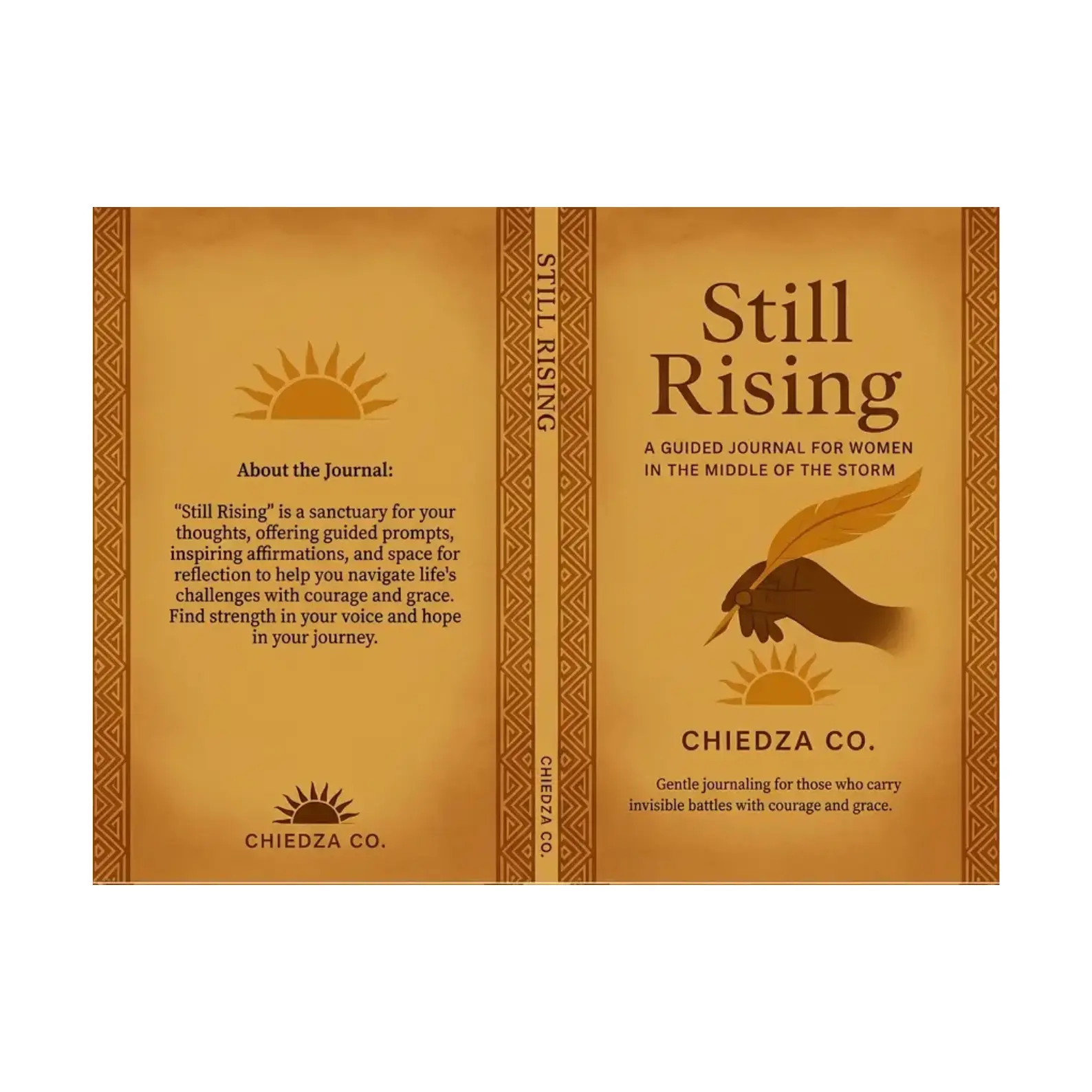
You can use the StillRising 30-Day Guided Journal for the challenge itself, then allow Becoming Light to carry you into the next season of gentle transformation.
The first week is not about fixing yourself. It is about telling the truth.
I have learned that the body often carries what the mouth has been trained to minimise. The grief of cancelled plans. The anger of not being believed. The exhaustion of explaining an invisible illness for the hundredth time. The quiet humiliation of needing help with things you once did without thinking.
We cannot gently rise while pretending we were never hurt.
Write: “The season I am in is…”
Do not make it sound beautiful. If the truth is “I am tired and uncertain,” let that be enough.
List three responsibilities, expectations, or emotions that feel heavier than they should. Beside each one, write: mine, shared, or not mine.
You may discover that you have been carrying other people’s comfort like it is a second handbag.
Write about one thing you have lost, postponed, or had to do differently. You do not have to turn the loss into a lesson today. Some things need to be mourned before they can be transformed.
Ask: Who taught me that rest must be earned?
Then write a new sentence: “My worth is not measured by how much I can produce while unwell.”
Spend five quiet minutes noticing your body. What feels tight? Heavy? Tender? Restless? Do not argue with the answer. Your body is not being dramatic. It is communicating.
Choose something uncomplicated: a warm drink, a familiar song, a soft blanket, prayer, sunlight through the window, or a message to someone safe.
Comfort is not a consolation prize. It is information.
Complete this sentence:
“This week, I gave myself permission to…”
If the answer is “admit I am struggling,” that is not a small answer. That is the beginning of honesty.
Pacing changed the way I understand strength.
Before, I often waited until my body was shouting before I listened. I treated the early whispers as inconveniences: the sudden heaviness, the headache, the change in vision, the need to lie down, the irritation that arrived before the fatigue.
Now I try to notice the whisper before it becomes a roar.
Pacing is not laziness. It is a practical relationship with capacity. It asks me to work with my energy instead of making promises on behalf of a body I have not consulted.
Check in during the morning, afternoon, and evening. Use words rather than numbers if numbers feel stressful: steady, fading, fragile, restored, overloaded.
You are collecting information, not grading yourself.
What tells you that you are approaching your limit? Maybe you become unusually quiet, lose words, feel dizzy, experience pain, or start rushing.
Write your signs down. Awareness is a form of protection.
Cut one task in half. Reply to one message instead of clearing your inbox. Wash only what you need. Work for ten minutes, then pause.
Small is not pointless. Small is repeatable.
Put one rest period into your day before the crash arrives. It may be five minutes in a chair or an hour in bed. Planned rest is not surrender. It is maintenance.
Write five things you can do on a difficult day. Include options that require almost nothing: listening to an audiobook, opening the curtains, drinking water, texting “I’m having a hard day,” or simply breathing.
Is there one appointment, prescription, message, form, or conversation you have been avoiding because it feels too difficult? Break it into the first reachable step. Find the number. Draft the message. Ask someone to sit with you while you do it.
Write: “My energy responded well to…”
This is the “Track” part of Believe. Track. Continue. You are building a personal map, not following a rigid formula.
For a journal designed around healing, reflection, and sustained care, explore The Aftercare Journal. Because care should not end simply because the emergency has passed.
I used to think boundaries were mostly about saying no. Now I understand them as instructions for safety.
A boundary can be a shorter visit. A closed door. A delayed response. A quieter room. A decision not to explain your pain to someone committed to misunderstanding it.
When your energy is limited, every environment has a cost. This week is about noticing the cost and creating more sanctuary around yourself.
Write down the people, spaces, conversations, and habits that leave you feeling scattered or depleted. You do not need to solve every item. You only need to see it clearly.
Try:
You do not need a twelve-slide presentation to justify a boundary.
Create a buffer between activities. Do not move directly from a demanding call into another responsibility if you can help it. Give your nervous system a doorway.
Choose a small area: a bedside table, desk, chair, or corner of the sofa. Remove one source of clutter and add one comforting object. Sanctuary does not require a dramatic home makeover. Sometimes it is just finding your charger.
Let someone help. Accept the lift, the meal, the reminder, the listening ear. Receiving support does not make you a burden. It makes care communal.
What are you pretending to be fine about? Write the truth privately. You do not have to perform wellness in your own journal.
Ask: What became safer when I stopped over-explaining?
Keep that answer close.

Gentle transformation is still transformation.
I do not need to become unrecognisable to prove that I have healed. Sometimes becoming looks like trusting myself sooner. Sometimes it looks like choosing an accessible path rather than the impressive one. Sometimes it looks like believing that my life can still hold beauty after it has changed shape.
This is not the week for pressure. It is the week for possibility.
Write about a day that feels sustainable: not perfect, productive, or enviable. What does it sound like? What is absent? What is present?
What did you want before survival became your full-time occupation? You do not have to pursue it immediately. Just write its name down and welcome it back.
Read one page. Send one email. Wear the colour you love. Open the document. Pray. Create. The action is not meant to prove anything. It is a gentle vote for the woman you are becoming.
Ask: What would make this goal kinder to my body?
Perhaps it needs breaks, remote access, a wheelchair-friendly setting, help from another person, or a slower timeline. Adaptation is not cheating. It is intelligent design.
Complete:
“I am a woman who…”
Try “listens,” “receives,” “creates,” “rests,” “asks,” “continues,” or “rises without abandoning herself.”
List the ways you have continued: not just the visible achievements. You attended the appointment. You rested before the crash. You told the truth. You kept going in a form nobody else could see.
Begin with:
“I am no longer available for…”
Then:
“I am making room for…”

The final two days are not a graduation ceremony where you are sent back into the world with a certificate and no support.
They are an invitation to continue.
Select three practices to carry forward:
Make each one small enough to survive a difficult day.
Write a simple aftercare promise:
“When life forces me to pause, I will…”
Perhaps you will believe your body sooner. Track your energy without shame. Continue with support instead of isolation. Return to your journal. Ask for help before the crisis becomes unmanageable.
That is the heart of the S.A.F.E.R.™ Framework and the Aftercare Mandate™ energy: safety, dignity, and what comes after.
You do not need to wait for a new month, a perfect Monday, or a sudden reserve of energy.
Begin with one page.
The StillRising 30-Day Guided Journal can hold this challenge with you, while Becoming Light offers a longer path into reflection, hope, and intentional transformation. You can also explore the wider Chiedza collection or visit the Journal Hub for more reflective resources.
Come to chiedzaco.com, choose the tool that meets you where you are, and join this challenge in the only way that matters:
Believe in your capacity for renewal. Track what your body is teaching you. Continue: gently, honestly, and at your own pace.
You are not behind.
You are not broken.
You are still becoming.